
First report of Fusarium incarnatum causing fruit rot of chili pepper in Indonesia
Article Sidebar
Main Article Content
Abstract
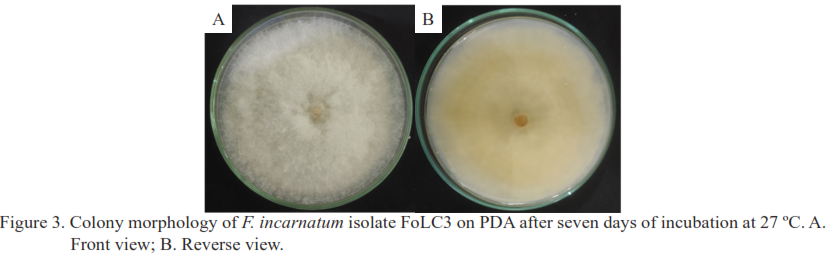
Chili pepper (Capsicum annuum L.) is a widely cultivated horticultural crop with significant potential as an export commodity. Fruit rot of chili pepper was recorded in Lubuk Cuik village, North Sumatra Province, Indonesia. One hundred and fifty symptomatic fruits were randomly collected from four locations using purposive random sampling. Fungal colonies were isolated from infected fruits until pure cultures were obtained. Pure colonies observed for macroscopic examination exhibited abundant, dense white aerial mycelia with a brown–yellowish base. Microscopic observations revealed numerous long and slender macroconidia, 3–5 septate, with a curved shape and tapering ends. Microconidia were rare, pyriform to obovate in shape, and mostly 0–1 septate. Chlamydospores were thick-walled, intercalary, globose, and produced singly or in chains. Molecular identification was performed using the internal transcribed spacer (ITS) and translation elongation factor (TEF-1α) regions. The pathogenicity of the eight Fusarium incarnatum isolates was tested twice. The morphological characteristics, phylogenetic analysis, and pathogenicity assay confirmed that all isolates were consistent with Fusarium incarnatum. This study represents the first confirmed report of F. incarnatum causing fruit rot of chili pepper in Indonesia.
Article Details

This work is licensed under a Creative Commons Attribution-NonCommercial 4.0 International License.
Authors retain copyright of their published articles and grant the journal the right of first publication.
All articles published in Jurnal Hama dan Penyakit Tumbuhan Tropika: Journal of Tropical Plant Pests and Diseases are licensed under the Creative Commons Attribution-NonCommercial 4.0 International (CC BY-NC 4.0) license.
This license permits others to share, copy, distribute, and adapt the published work for non-commercial purposes, provided that appropriate credit is given to the original author(s) and the journal.
References
Backhouse D, Burgess LW, & Summerell BA. 2001. Biogeography of Fusarium. In: Summerell BA, Leslie JF, Backhouse D, Bryden WL, & Burgess LW (Eds.). Fusarium Paul E. Nelson Memorial Symposium. pp. 122–137. American Phytopathological Society Press. Minnesota.
Balamurugan A & Kumar A. 2023. Postharvest fruit rot of bell pepper (Capsicum annuum L.): Pathogenicity and host range of Alternaria alternata. Sci. Hortic. 319: 112156. https://doi.org/10.1016/j.scienta.2023.112156
Carbone I & Kohn LM. 1999. A method for designing primer sets for speciation studies in filamentous ascomycetes. Mycologia. 91(3): 553–556. https://doi.org/10.2307/3761358
Chen X, Liu H, Dong L, Shi J, Ma Z, Yan L, & Yin Y. 2025. Identification and characterization of Fusarium incarnatum causing leaf spot and fruit rot on luffa in China. Plants. 14(6): 845. https://doi.org/10.3390/plants14060845
Delai C, Muhae-Ud-Din G, Abid R, Tian T, Liu R, Xiong Y, Ma S, & Ghorbani A. 2024. A comprehensive review of integrated management strategies for damping-off disease in chili. Front. Microbiol. 15: 1479957. https://doi.org/10.3389/fmicb.2024.1479957
Engalycheva I, Kozar E, Frolova S, Vetrova S, Tikhonova T, Dzhos E, Engalychev M, Chizhik V, Martynov V, Shingaliev A, Dudnikova K, Dudnikov M, & Kostanchuk Y. 2024. Fusarium species causing pepper wilt in Russia: Molecular identification and pathogenicity. Microorganisms. 12(2): 343. https://doi.org/10.3390/microorganisms12020343
Faisal AF & Mustafa YF. 2025. Chili pepper: A delve into its nutritional values and roles in food-based therapy. Food Chem. Adv. 6: 100928. https://doi.org/10.1016/j.focha.2025.100928
Fatimoh AO, Moses AA, Adekunle OB, & Dare OE. 2017. Isolation and identification of rot fungi on post-harvest of pepper (Capsicum annuum L.) fruits. AASCIT J. Biol. 3(5): 24–29.
Ferniah RS, Daryono BS, Kasiamdari RS, & Priyatmojo A. 2014. Characterization and pathogenicity of Fusarium oxysporum as the causal agent of Fusarium wilt in chili (Capsicum annuum L.). Microbiol. Indones. 8(3): 121–126. https://doi.org/10.5454/mi.8.3.5
Frans M, Aerts R, Van Laethem S, & Ceusters J. 2017. Environmental effects on growth and sporulation of Fusarium spp. causing internal fruit rot in bell pepper. Eur. J. Plant Pathol. 149(4): 875–883. https://doi.org/10.1007/s10658-017-1235-4
Huang X & Madan A. 1999. CAP3: A DNA sequence assembly program. Genome Res. 9(9): 868-877. https://doi.org/10.1101/gr.9.9.868
Hutauruk D, Suryanto D, & Munir E. 2016. Asai isolat bakteri kitinolitik Bacillus sp. BK17 pada media pembawa tanah gambut dan kompos janjang kelapa sawit dalam menghambat pertumbuhan jamur patogen Sclerotium rolfsii dan Fusarium oxysporum pada kecambah cabai [Assay of chitinolytic bacterial isolate of Bacillus sp. BK17 in peat and palm oil bunch compost as carrier media in inhibiting Sclerotium rolfsii and Fusarium oxysporum of chilli seedlings]. J. Trop. Plant Pests Dis. 16(1): 61–70. https://doi.org/10.23960/j.hptt.11661-70
Ishak NF, Wan Azhar WMA, Ahmad S, Khairuddin AU, & Laboh R. 2024. First report of fruit rot caused by Fusarium incarnatum-equiseti species complex on greenhouse bell pepper in Malaysia. Plant Dis. 108(1): 211. https://doi.org/10.1094/PDIS-06-23-1076-PDN
Jamel DS, Hatem MW, & Kareem TA, 2025. The impact of organic amendments (vermicompost and fermented cow manure) on managing corn stalk rot disease caused by Fusarium incarnatum. J Trop Plant Pests Dis, 25(2): 350–360. https://doi.org/10.23960/jhptt.225350-360
Tamura K, Stecher G, & Kumar S. 2021. MEGA11: Molecular evolutionary genetics analysis version 11. Mol. Biol. Evol. 38(7): 3022–3027. https://doi.org/10.1093/molbev/msab120
Leslie JF & Summerell BA. 2006. The Fusarium Laboratory Manual. Blackwell Publishing Ltd., Ames, Lowa, USA.
Li HY, Guo W, Liu D, & Li MQ. 2018. First report of Fusarium semitectum causing root rot of greenhouse pepper (Capsicum annuum) in China. Plant Dis. 102(10): 2032–2032. https://doi.org/10.1094/PDIS-11-17-1704-PDN
Maryani N, Lombard L, Poerba YS, Subandiyah S, Crous PW, & Kema GHJ. 2019. Phylogeny and genetic diversity of the banana Fusarium wilt pathogen Fusarium oxysporum f.sp. cubense in the Indonesian centre of origin. Stud. Mycol. 92(1): 155–194. https://doi.org/10.1016/j.simyco.2018.06.003
Mathur S & Utkhede R. 2004. Molecular detection of Fusarium subglutinans, the causal organism of internal fruit rot in greenhouse peppers. Can. J. Plant Pathol. 26(4): 514–521. https://doi.org/10.1080/07060660409507172
Naz F, Tariq A, Rauf CA, Abbas MF, Walsh E, Luo J, Kingsley K, Zhang N, & Bennett JW. 2018. First report of Botrytis cinerea causing gray mold disease of bell pepper (Capsicum annuum) fruit in Pakistan. Plant Dis. 102(7): 1449. https://doi.org/10.1094/PDIS-10-17-1632-PDN
O’Donnell K, Sutton DA, Rinaldi MG, Gueidan C, Crous PW, & Geiser DM. 2009. Novel multilocus sequence typing scheme reveals high genetic diversity of human pathogenic members of the Fusarium incarnatum-F. equiseti and F. chlamydosporum species complexes within the United States. J. Clin. Microbiol. 47(12): 3851–3861. https://doi.org/10.1128/jcm.01616-09
Ramdial H, Hosein F, & Rampersad SN. 2016. First report of Fusarium incarnatum associated with fruit disease of bell peppers in Trinidad. Plant Dis. 100(2): 526–526. https://doi.org/10.1094/PDIS-05-15-0550-PDN
Ramdial H, Latchoo RK, Hosein FN, & Rampersad SN. 2017. Phylogeny and haplotype analysis of fungi within the Fusarium incarnatum-equiseti species complex. Phytopathology. 107(1): 109–120. https://doi.org/10.1094/PHYTO-05-16-0209-R
Saitou N & Nei M. 1987. The neighbor-joining method: A new method for reconstructing phylogenetic trees. Mol. Biol. Evol. 4(4): 406–425. https://doi.org/10.1093/oxfordjournals.molbev.a040454
Soesanto L, Sari LY, Mugiastuti E, & Manan A. 2021. Cross application of entomopathogenic fungi raw secondary metabolites for controlling fusarium wilt of chili seedling. J. Trop. Plant Pests Dis. 21(2): 82–90. https://doi.org/10.23960/j.hptt.11661-70
Summerell BA, Laurence MH, Liew EC, & Leslie JF. 2010. Biogeography and phylogeography of Fusarium: A review. Fungal Divers. 44(1): 3–13. https://doi.org/10.1007/s13225-010-0060-2
Sumutprov. 2023. Panen Raya di Desa Lubuk Cuik, Pj Gubernur Dukung Pembangunan Rumah Produksi Pasta Cabai Merah [Great Harvest in Lubuk Cuik Village, Acting Governor Supports Construction of Red Chili Paste Production House]. https://sumutprov.go.id/artikel/artikel/panen-raya-di-desa-lubuk-cuit-pj-gubernur-dukung-pembangunan-rumah-produksi-pasta-cabai-merah. Accessed 24 December 2024.
Tamura K, Stecher G, & Kumar S. 2021. MEGA11: molecular evolutionary genetics analysis version 11. Mol. Biol. Evol. 38(7): 3022–3027. https://doi.org/10.1093/molbev/msab120
Tariq A, Naz F, Altaf R, Jabeen Z, Rauf CA, Irshad G, Raja MU, Shaheen FA, Sultana T, Aslam M, Bennett JW, & Zhang N. 2018. First report of fruit rot of bell pepper caused by Fusarium incarnatum in Pakistan. Plant Dis. 102(12): 2645. https://doi.org/10.1094/PDIS-02-18-0221-PDN
Umesha S, Manukumar HM, & Raghava S. 2016. A rapid method for isolation of genomic DNA from food-borne fungal pathogens. 3 Biotech. 6(2): 123. https://doi.org/10.1007/s13205-016-0436-4
Villani A, Proctor RH, Kim HS, Brown DW, Logrieco AF, Amatulli MT, Moretti A, & Susca A. 2019. Variation in secondary metabolite production potential in the Fusarium incarnatum-equiseti species complex revealed by comparative analysis of 13 genomes. BMC Genomics. 20(1): 314. https://doi.org/10.1186/s12864-019-5567-7
Wang JH, Feng ZH, Han Z, Song SQ, Lin SH, & Wu AB, 2013. First report of pepper fruit rot caused by Fusarium concentricum in China. Plant Dis. 97(12): 1657–1658. https://doi.org/10.1094/PDIS-03-13-0325-PDN
Wang MM, Chen Q, Diao YZ, Duan WJ, & Cai L. 2019. Fusarium incarnatum-equiseti complex from China. Persoonia. 43(1): 70–89. https://doi.org/10.3767/persoonia.2019.43.03
White TJ, Bruns T, Lee SJWT, & Taylor J. 1990. Amplification and direct sequencing of fungal ribosomal RNA genes for phylogenetics. In: Innis MA, Gelfand DH, Sninsky JJ, & White TJ (Eds.). PCR Protocols: A Guide to Methods and Applications. pp. 315–322. Academic Press. California.
Xia JW, Sandoval-Denis M, Crous PW, Zhang XG, & Lombard L. 2019. Numbers to names-restyling the Fusarium incarnatum-equiseti species complex. Persoonia. 43(1): 186–221. https://doi.org/10.3767/persoonia.2019.43.05
Yang J, Kharbanda PD, Howard RJ, & Mirza M. 2009. Identification and pathogenicity of Fusarium lactis, causal agent of internal fruit rot of greenhouse sweet pepper in Alberta. Can. J. Plant Pathol. 31(1): 47–56. https://doi.org/10.1080/07060 66090 9507571
Zakaria L. 2023. Fusarium species associated with diseases of major tropical fruit crops. Horticulturae. 9(3): 322. https://doi.org/10.3390/horticulturae9030322
Zhu XQ, Liu DM, Hong QC, Lu YF, & Pei DL. 2021. First report of chili pepper fruit rot caused by Fusarium incarnatum in China. Plant Dis. 105(10): 3304. https://doi.org/10.1094/PDIS-09-19-1996-PDN